
Why Tackling Modern Slavery in Care is so Complex
The Safeguarding Gap
In the UK, modern slavery is tackled, among other approaches, through training frontline professionals to recognise and report signs of exploitation among vulnerable people. If carers were to wait to be identified as victims of modern slavery, they would wait forever. It could be argued that the authority with responsibility for protecting these workers is the local authority (LA), given its role as a commercial purchaser of care services. While local authorities may not consider themselves “commercial” organisations, they enter into contracts and make payments for services, effectively operating as buyers in a supply chain. By procuring home care and live-in care through commissioned contracts, the LA becomes part of a supply chain in which care workers constitute the labour component of the services it acquires. Under Section 54 of the Modern Slavery Act 2015, this positions local authorities, like any other organisation procuring goods or services, as entities expected to ensure that their supply chains are free from slavery, servitude, forced or compulsory labour and human trafficking. Several local authorities have taken the proactive step of publishing modern slavery statements and acknowledging the workforce within their procured services as part of their supply chains. By adopting such measures, local authorities demonstrate how commissioning bodies can extend accountability beyond statutory thresholds. Since most care providers fall below the £36 million turnover required for Modern Slavery Act reporting, local authorities have a critical role in closing this oversight gap by embedding workforce protections into contracts, requiring supplier declarations on fair labour standards and actively monitoring compliance to safeguard carers from exploitation within publicly funded care services.
However, with the above arrangement, there are several structural conflicts which should not be ignored. On one side, the Care Act 2014 directs local authorities to safeguard adults with care and support needs, typically the older or disabled person receiving care. Within this framework, the carer is often viewed as a potential risk or suspect of abuse not as someone in need of protection.
On the other side, the Modern Slavery Act 2015 would then place a legal and moral duty on the same local authorities to ensure that all workers delivering publicly commissioned services, including home care and live-in care, are protected from exploitation. In this case, the potential abuser or exploiter could just as easily be the care recipient, their family or even the agency itself.
This contradiction becomes even more troubling when we look at how care is commissioned. Many local authorities purchase home care on ‘time and task’ contracts paying agencies only for short visits, sometimes as little as 15-minute slots, despite carers working 14–16-hour days. These long hours, coupled with low pay, lack of rest and constant availability, are all clear indicators of forced labour under both ILO Convention No. 29 and the UK Government’s Modern Slavery Assessment Tool (MSAT).
So, when the same authority that commissions exhausting, underpaid work is also the one tasked with identifying modern slavery, a clear conflict of interest emerges. It is unrealistic to expect the commissioner to acknowledge exploitation that their own procurement model may be sustaining. Under the Modern Slavery Act 2015, local authorities are designated First Responder Organisations, with statutory duties to identify potential victims, recognise indicators of exploitation and refer cases to the National Referral Mechanism (NRM). This responsibility exists in direct conflict with their parallel role as commissioners of care services. For carers, this dual function presents a unique dilemma. Seeking help from a local authority that simultaneously commissions the very service under which exploitation occurs can be complex and discouraging. How can a local authority fulfil its statutory duty to refer victims of modern slavery when those victims are produced by its own commissioning practices? In contrast, for other residents within the locality, such as general members of the public or service users, approaching the local authority for support does not carry this inherent conflict of interest. As highlighted by the Homecare Association (2025), when local authorities procure care at rates that do not allow providers to pay even the legal minimum wage, they risk enabling what has been described as “state-sponsored labour exploitation.”
“Ministers tell everyone they are introducing a Fair Pay Agreement to attract British workers and avoid the need for international recruitment but this is a fantasy. Our research shows there isn’t enough money in the system even to pay all homecare workers the minimum wage of £12.21 per hour. It’s a scandal of epic proportions on this government’s watch. And it must stop” (Homecare Association, 2025).
One might then understand why there appears to be no public body willing or able to stand up for the protection of domiciliary carers because without adequate funding, there is no viable solution. The result is a cycle in which underfunding perpetuates inaction. Those who could intervene are aware of the deep financial pressures shaping care, yet domiciliary carers are often treated as outside the remit of local authorities’ safeguarding responsibilities. This allows the system to justify its failure to address exploitation, even when the causes are well understood. In practice, commissioning bodies often avoid taking responsibility for the exploitation of carers by pointing to legal technicalities, because carers are employed by healthcare agencies or private families, authorities claim the law does not require them to intervene. This allows the system to appear compliant while leaving the very workers it funds unprotected.
This is why the Independent Anti-Slavery Commissioner’s current emphasis on training frontline professionals to spot victims is not fit for purpose in the care sector. The model assumes that victims are visible but live-in and domiciliary carers are not. Their workplaces are private homes, hidden from public view, often in towns or villages far from where they live.
A police officer might be trained to notice warning signs in a random encounter, for example, someone who doesn’t know where the local supermarket is might be flagged as confined or trafficked. But for a live-in carer who has just arrived from Slough to work two weeks in Axminster not knowing the local area is entirely normal, it’s part of the job.
Neighbours rarely see them. Even visiting relatives of the person receiving care, carers have reported them as contributors of the exploitation, expecting the carer to cook for them, do laundry or care for their pets or children. In these circumstances, no one will “spot” the carer as a victim.
When official systems fail to act, people often turn to the public for moral support and collective pressure. Yet for carers, this route is far more complicated. The “public” they would appeal to is often the very group receiving their services, older people, disabled people and their families, many of whom depend on affordable or publicly funded care. In such circumstances, public sympathy can be muted by self-interest: the same citizens who might ordinarily demand fair pay and decent work may, consciously or not, support policies that keep care costs low. This leaves carers with few natural allies, isolated between an unresponsive system and a public that benefits from their underpayment. It is another reason why empowerment and collective organisation among carers themselves are so crucial, without their own voice, no one will speak for them.
Rational for Training
The only realistic form of protection comes from self-recognition and self-referral, carers being able to identify the signs of exploitation in their own situation, understand their rights and know how to report it safely. That is exactly why the free course, Understanding Modern Slavery in the UK Social Care Sector was developed by Social Care Research. The course is grounded in research and takes an empowerment approach, to bridge the safeguarding gap the system itself created.
A course presented in two ways
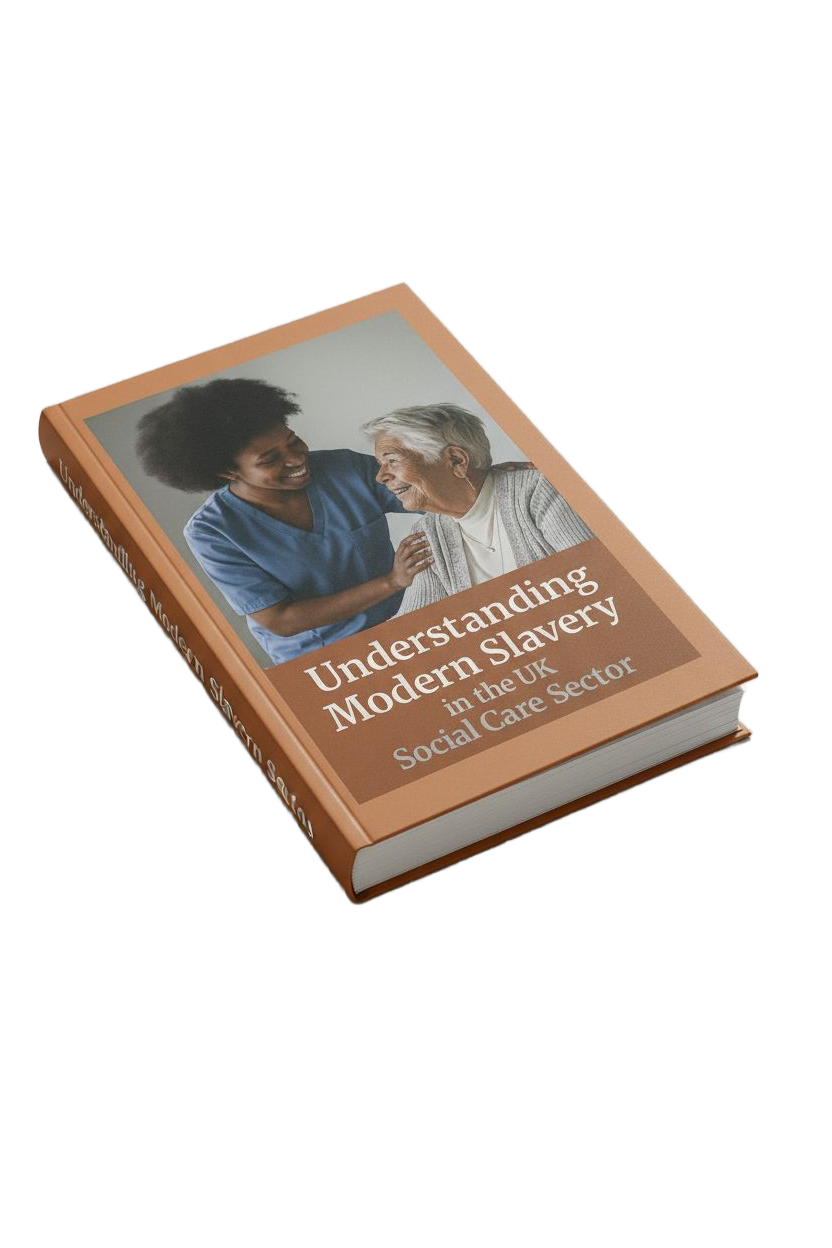
Online Book £25
Specifically for busy policymakers, care agencies and families of people drawing on care.
This publication is an adaptation of the free interactive online course Understanding Modern Slavery in the UK Social Care Sector. The course is presented in two complementary formats: a free interactive online course designed specifically for carers and an online book created for care agencies, local authorities, policymakers and family members of people drawing on care.
The free interactive course follows a step-by-step learning journey, where each section must be completed before the next opens. This structure promotes deep reflection and a systematic understanding, enabling carers to engage meaningfully with the complexities of modern slavery. However, this format may not always suit everyone. For instance, a local authority may prefer to go straight to Module 5: Commissioned to Fail – How Local Authority Models Fuel Exploitation to examine how commissioning frameworks and budget-driven models can contribute to poor working conditions and potential breaches of duty under the Care Act 2014 and the Modern Slavery Act 2015. A care agency might wish to focus directly on Module 6: Profiting from Care – How Agencies Exploit Their Workforce to understand how employment practices and pay models may unintentionally perpetuate exploitation.
A family drawing on care may want to explore Module 7: Behind Closed Doors – When Families Turn Carers into Servants to reflect on household dynamics and recognise how easily boundaries can blur into unfair treatment. Meanwhile, Home Office policymakers may wish to study Module 8: Modern Traffickers – Trafficking Through ‘Safe’ Routes to understand how more than 710,000 migrants entered the UK through the Health and Care Worker Visa and how better foresight and regulation could prevent such large-scale vulnerabilities in the future. Trade unions, charities and other organising groups can go directly to Module 9: 809,000 Voices – From Isolation to Influence to learn how to organise and strengthen the care workforce. This module draws on research from the Centre for Care’s Care Workforce Change group, which links experts across five universities, three major charities and the UK’s Office for National Statistics. Their work underscores why collective action, representation and collaboration are essential to transforming carers’ conditions and ensuring lasting systemic change in the social care sector.
This is where the online book comes in. It offers the same depth of insight in a format that allows readers to jump directly to the sections most relevant to them, providing flexibility without losing substance. The book allows busy professionals and stakeholders to quickly access the evidence, arguments and lived experiences that matter most to their roles, while still benefiting from the same evidence-based approach as the full course.
Together, the course and this book form a single mission, to make knowledge accessible to every person in the social care ecosystem, from policymakers and care agencies to family members of people drawing on care and carers themselves. Modern slavery in social care is a complex issue, one that no single group can solve alone. True understanding, prevention and empowerment must therefore become shared responsibilities across the entire system.
We believe that most people can protect themselves, prevent harm and even hold perpetrators to account if they are well trained, well informed and well resourced. Waiting for carers to be identified, referred, supported or to go through lengthy court processes often leads to long periods of uncertainty and significant emotional and financial cost to the individual, to the system and to society. This course and book are designed to change that by making prevention and empowerment the first line of defence against modern slavery.
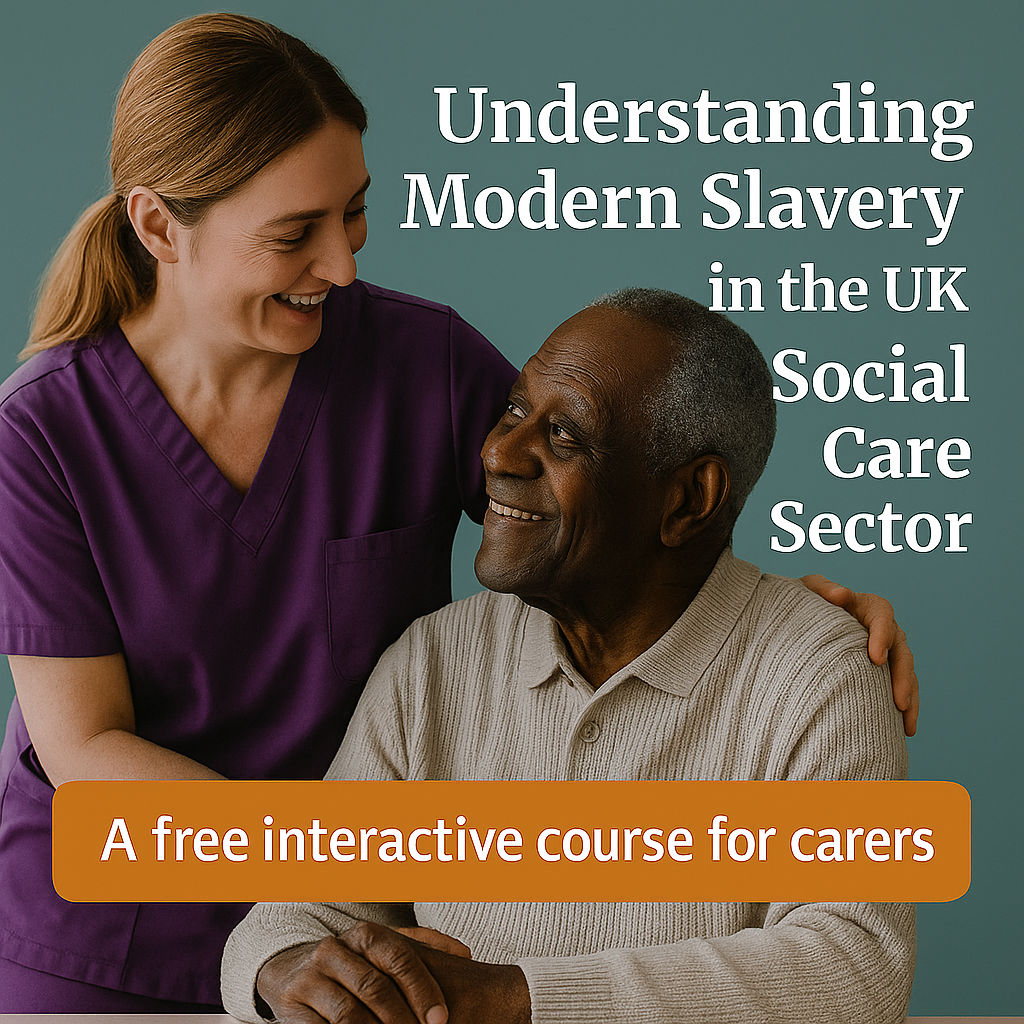
Free Interactive Course for Carers
Knowledge of the Modern Slavery Act 2015 is your first line of protection.
Working in private homes presents many challenges, from the lack of clear employment rights to excessive workloads and low pay. This free interactive course introduces you to the Modern Slavery Act 2015, the only piece of legislation that directly empowers you to recognise, report and challenge exploitation. It is a law you can hold on to, organise around and use as a foundation for collective action to improve your working conditions and wellbeing.
The main goal of this training is prevention. Through real-life examples, practical exercises and clear guidance, you will learn how to identify risk, protect yourself and support others. With over 809,000 carers in the UK, this course shows how your shared voices and experiences can become a powerful force for change, building unity, awareness and dignity across the care sector.